What Are AI Agents and How Do They Work in Production
What Are AI Agents and How Do They Work in Production? A practical guide to goals, tools, orchestration, guardrails, and metrics for shipping reliable systems.
By Eddy Tools Team · Editorial team
Published 6 min read
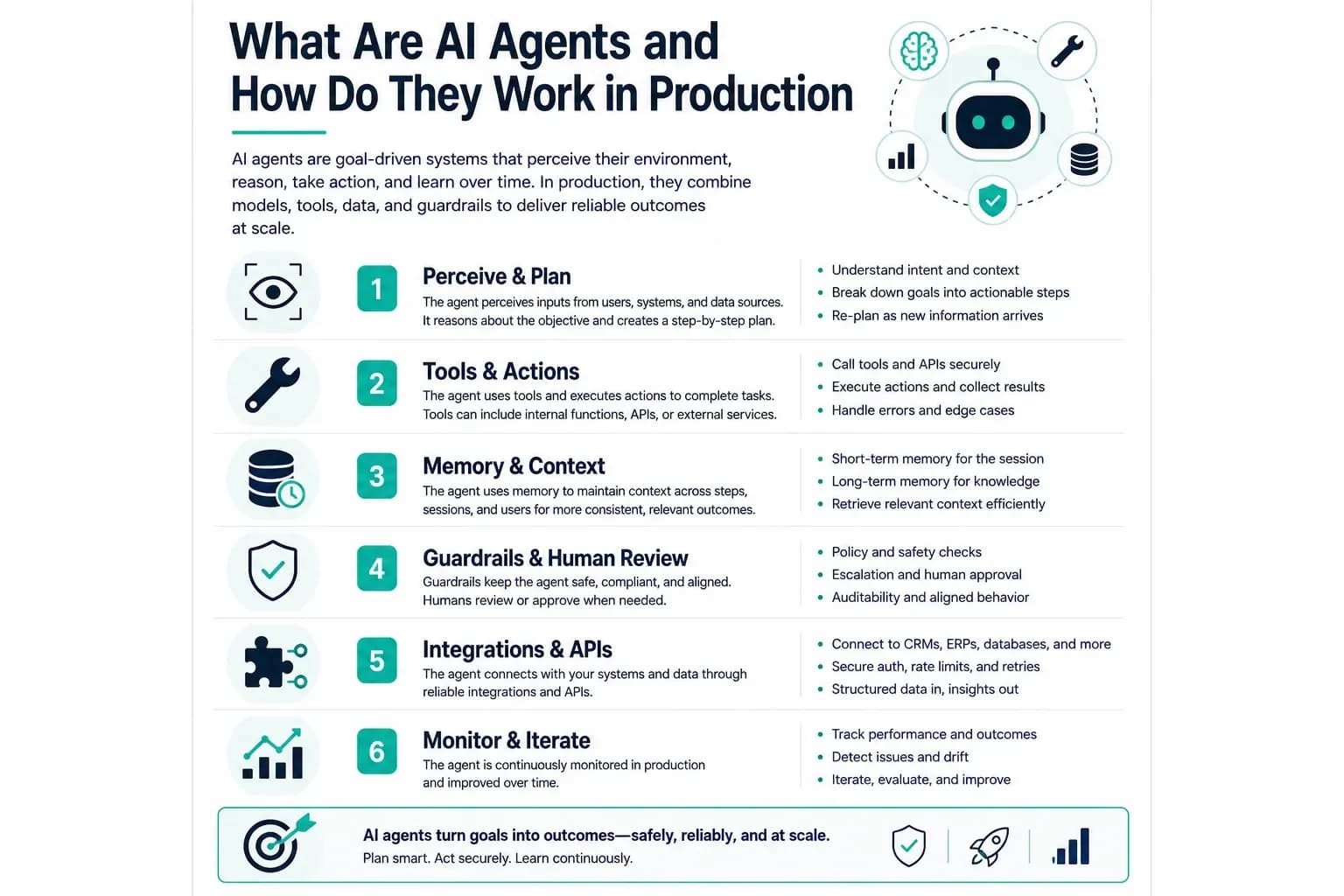
What Are AI Agents and How Do They Work in Production
AI agents are software systems that pursue goals on your behalf — observing context, deciding what to do next, calling tools, and iterating until a task is complete or a human steps in. They differ from chatbots that only respond in a single turn. In production, agents connect to real APIs, databases, and workflows with guardrails, logging, and accountability.
This guide answers what AI agents are and how they work in production: the core loop, the stack behind reliable agents, deployment patterns for business operations, and the guardrails teams need before shipping. Whether you are evaluating agent platforms or building your first production workflow, you will leave with a practical mental model — not hype.

What Are AI Agents and How Do They Work in Production — from goals and context to tools, orchestration, and production guardrails.
What Is an AI Agent (Really)?
An AI agent is a goal-directed system powered by a language model that can take actions through tools. It receives a mission — resolve a support ticket, reconcile invoices, schedule maintenance when vibration exceeds threshold — and works through sub-steps autonomously within defined boundaries.
Agents vs. chatbots vs. automation scripts
A chatbot answers questions in one or a few turns. A traditional automation script follows fixed if/then rules. An agent sits between them: it can plan, adapt when data changes, and choose among multiple tools. That flexibility requires explicit guardrails in production.
The minimum viable agent
At minimum, a production agent needs four things: clear success criteria, access to relevant context, a set of permitted tools, and a loop that continues until the goal is met, blocked, or escalated. Without all four, you have a demo — not an agent you can operate at scale.
The Production Agent Stack
Understanding what AI agents are and how they work in production starts with the stack. Teams that ship reliably treat agents as distributed systems with an AI reasoning layer — not as a single prompt in a chat window.
Perception and context
Agents need the right inputs at the right time: RAG over knowledge bases, live CRM or ERP data, ticket history, or IoT telemetry. Production systems use retrieval and structured memory rather than dumping everything into one prompt.
Reasoning and planning
The model decides what to do next: which tool to call, what parameters to pass, or when to stop. Teams cap iteration counts, enforce timeouts, and require confidence thresholds before irreversible actions.
Tools and actions
Tools are how agents affect the world: send email, create tickets, update records, run queries, or call specialized agents. Each tool needs a strict schema, least-privilege auth, and idempotency where side effects matter.
How AI Agents Execute Work in Production
Most production agents follow a repeatable execution pattern. Once you recognize it, you can evaluate platforms, design orchestration, and debug failures systematically.
The observe–plan–act loop
Each cycle begins with observation: current state, user message, tool results, or environmental signals. The agent plans the next action, then acts by invoking a tool or producing a final response. Results feed the next observation until success, max steps, policy violation, or human approval. Logging every step is non-negotiable — when an agent misfires, you need a trace of inputs, model version, tool calls, and outputs.
Single-agent vs. multi-agent workflows
A single agent with a rich toolset handles many tasks. Multi-agent setups assign roles: researcher, writer, reviewer, executor. Multi-agent shines when domains are specialized or separation of duties reduces risk.
Human-in-the-loop checkpoints
Not every step should be autonomous. Production agents define approval gates for high-impact actions: payments, external communications, production config changes, or regulated operations. Humans approve high-impact steps before the agent completes them.
Guardrails, Observability, and Reliability
The difference between a prototype and a production agent is not model intelligence alone — it is everything wrapped around the model.
Safety boundaries and policy enforcement
Define what agents must never do: access certain data, contact customers without review, or execute destructive operations. Implement policy via tool allowlists, middleware validators, and post-action audits.
Evaluation and continuous improvement
Build eval sets from real tasks before launch; monitor completion rate, escalation rate, and cost per outcome after.
Cost, latency, and model selection
Route simple steps to smaller models, cache retrieval, and set budgets per workflow.
From Proof of Concept to Production Deployment
Most organizations have a successful demo; the gap is operational readiness.
Start with one narrow, measurable workflow
Pick a task with clear success criteria and bounded tools — ticket triage, lead enrichment, or inventory review. Ship end-to-end with logging and a human checkpoint. Expand only after metrics stabilize.
Integrate with systems of record
Agents deliver value when they read and write where work already happens: CRM, ERP, ticketing, or MES. Use official APIs and service accounts so agent actions stay auditable alongside human actions.
Define ownership and runbooks
Assign an owner for each agent and document runbooks for common failures. Agents without owners break silently after the next API change.
My Insights
Teams overinvest in model selection and underinvest in tool design and observability. The bottleneck is whether the agent can reliably fetch the right record, respect permissions, and leave a trace when something goes wrong.
Treat your first production agent like a microservice: SLA, dashboard, kill switch, and human review on early workflows.
Frequently Asked Questions
What are AI agents and how do they work in production?
AI agents are goal-directed systems that use language models to observe context, plan actions, and call tools in a loop until a task completes or escalates. In production, they connect to real business systems with guardrails, logging, human approval gates, and evaluation.
How is an AI agent different from traditional automation?
Traditional automation follows fixed rules and breaks when inputs fall outside predefined paths. AI agents adapt to varied inputs, choose among multiple tools, and replan when conditions change. That flexibility requires stronger guardrails, but it enables tasks too brittle to script with rules alone.
What do you need before deploying an AI agent to production?
You need scoped tools with least-privilege access, clear success criteria, step-by-step logging, evaluation datasets, human-in-the-loop gates for high-impact actions, and an owner responsible for monitoring and updates.
When should you use multi-agent systems instead of a single agent?
Use multiple agents when tasks require distinct expertise, when separation of duties reduces risk, or when parallel work speeds throughput. Single agents are simpler to operate — prefer them until complexity is justified by measured bottlenecks.
How do you measure whether a production AI agent is successful?
Track task completion rate, escalation rate, cost per successful outcome, latency, and business outcomes tied to the workflow. Combine automated evals with periodic human review of traces to catch quality drift before users complain.
Ready to deploy AI agents in production?
Request a service consultation — we will map your workflows, recommend an agent architecture, and outline a pilot you can ship in weeks.
Request a Service Consultation Explore Services App Development
Editorial note: Eddy Tools is an AI development and consulting company. Articles are written by the Eddy Tools editorial team and may mention our own services and the tools we build with.
Want help putting this into practice?
Book an architecture review and we will map it onto your workflows.
Keep reading

From POC to Production: Shipping AI Features
From POC to production: why AI demos stall, a four-gate sequence for shipping AI features safely, and the signals that mean you should kill the project instead.
Aug 14, 2026 · 7 min read

Building Operator Dashboards for AI Systems
Operator dashboards for AI systems: the four signal layers to instrument, what belongs on the screen, and the anti-patterns that turn a dashboard into wallpaper.
Aug 10, 2026 · 7 min read
AI Guardrails and Human-in-the-Loop Design
AI guardrails explained: a three-layer design for production AI agents — scope permissions, validate actions, and route the decisions that need a person.
Aug 7, 2026 · 7 min read